3.3 Measurement of velocity and
discharge
Defination
Velocity : This refers to how
quickly the water is moving. [Measured
in feet
per second (ft/s).]
Discharge : discharge refers
to the water generated by the facility.
It may
be dewatering water, wash water,
stormwater,
or any combination of these. This term
is
comparable to “flow” which is used here
in
reference to receiving water flow.
[Usually site
discharge is measured in gallons per
minute
(gpm).
Example
Of Measurement
Velocity
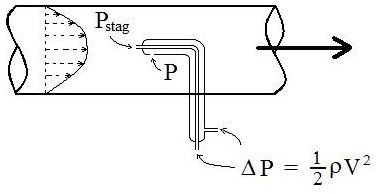
Measurement with a Pitot Tube

For pitot tube measurements and calculations, the
reference plane is taken to be at the height of the pitot tube measurements, so
the equation for stagnation pressure becomes:
Pstag = P + ½
ρV2 , which can be rearranged to: V = (2ΔP/ρ)1/2
Where ΔP = Pstag – P.
The pressure difference, Δp, (or Pstag – P), can be measured directly with a pitot
tube like the third U-tube in the figure above, or with a pitot tube like that
shown in the figure at the right. This is a concentric pitot tube. The inner
tube has a stagnation pressure opening (perpendicular to the fluid flow) and
the outer tube has a static pressure opening (parallel with the fluid flow).
Example Calculation
Consider a pitot tube being used to
measure air velocity in a heating duct. The air is at 85 oF and 16 psia. The pitot tube registers a pressure
difference of 0.021 inches of water (Pstag – P).
Calculate the velocity of the air at that point in the duct?
Solution: Convert the pressure
difference of 0.021 inches of water to lb/ft2 (psf) using
the conversion factor, 5.204 psf/in water.
0.021
inches of water = (0.021)(5.204) psf = 0.1093 psf
The density of air at 85oF and 16 psia can be calculated using the ideal gas
law, to be 0.002468 slugs/ft3.
Now V can be
calculated: V = (2ΔP/ρ)1/2 =
[(2)(0.1093)/0.002468] 1/2 = 9.41 ft/se
METHODS OF DISCHARGE MEASUREMENTS
Volumetric and weight method {Q = V/t
} {V = m/p = G/pG}
- the
most precise but: only for relatively small discharges (necessary volume of
tank), mainly for calibration of flow meters
Pipe flow meters based on flow
contraction
Orifice meter

– the
simplest, small laying-out length, but: large losses
Nozzle
meter

-
simpler and less expensive than a venturi meter, but not as simple as an
orifice meter
but medium losses
Venturi meter

– more complicated shape, large laying-out
length
but:
small losses
Example
of Calculation for Discharge (Venturi Meter)
A
venturi meter is connected at the main and throat sections by tubes filled with
the fluid being metered by a differential mercury manometer. Prove that for any
flow the reading is unaffected by the slope of the meter.
If
the mains diameter is
in. and the throat
diameter
in., calculate
the flow of fuel oil in gals./hr. if its relative
density relative to water is 0.8 and the difference of level of the mercury
columns is 7 in.
Use
a direct application of Bernoulli's theorem taking the relative density of
mercury to water as 13.6 and the meter coefficient as 0.96.

Applying Bernoulli:

But for a given flow and are constant:
 (3)
(3)
is
constant
Now
the pressures at level
, in the
-tube are equal and if the
subscript
refers to mercury,
then:
or:


where C = Constant
Now:


From
which:

Thus
the flow of oil in gallons/hour

Solution
The flow of
oil in gallons/hour is 4515

Comments
Post a Comment